Unclaimed rewards returned to you
Support | 415-386-8600
Employee incentives may feel more thoughtful when recognition is specific, timely, easy to receive, aligned with documented criteria, and adaptable to recipient preferences. No reward can guarantee that a recipient experiences it as sincere.
Available reward types may include gift cards, prepaid products, direct payments, merchandise, charitable giving, or optional branded items. Catalog, geographic availability, fees, eligibility, expiration, and tax treatment vary by program and recipient location.
Recognition can acknowledge a contribution, but it does not by itself establish engagement, trust, performance, or retention. A useful program combines clear criteria, timely communication, recipient choice, accessible delivery, manager judgment controls, and consistent administration. Technology can support those processes without proving sincerity or business impact.
GRATITUDE REQUIRES FAIR PROCESS
Author Sybil F. Stershic has argued that employee experience can influence customer experience and that employees should feel valued. Treat that perspective as a design prompt rather than evidence that a recognition program causes customer or business outcomes.
Related source: Taking Care of the People Who Matter Most: A Guide to Employee-Customer Care, Sybil F. Stershic.
A company-wide thank-you campaign may include email, branded merchandise, or workplace messaging, yet employees can interpret the same gesture differently. Recognition is one part of the employment experience; it does not replace fair pay, manageable workload, safe conditions, benefits, development, or supportive management.
Design recognition around observable contributions and documented, role-appropriate criteria. Provide comparable opportunities across locations, shifts, employment arrangements, disability access needs, and roles that have different visibility. Allow private recognition, a no-gift option, or an equivalent choice, and obtain consent before publicizing a recipient’s name, image, or contribution.
Specific communication, reasonable timing, and preference input may make a program more relevant. Measure administration, access, delivery, and employee feedback rather than claiming that a gift creates creativity, focus, loyalty, morale, or sincerity.
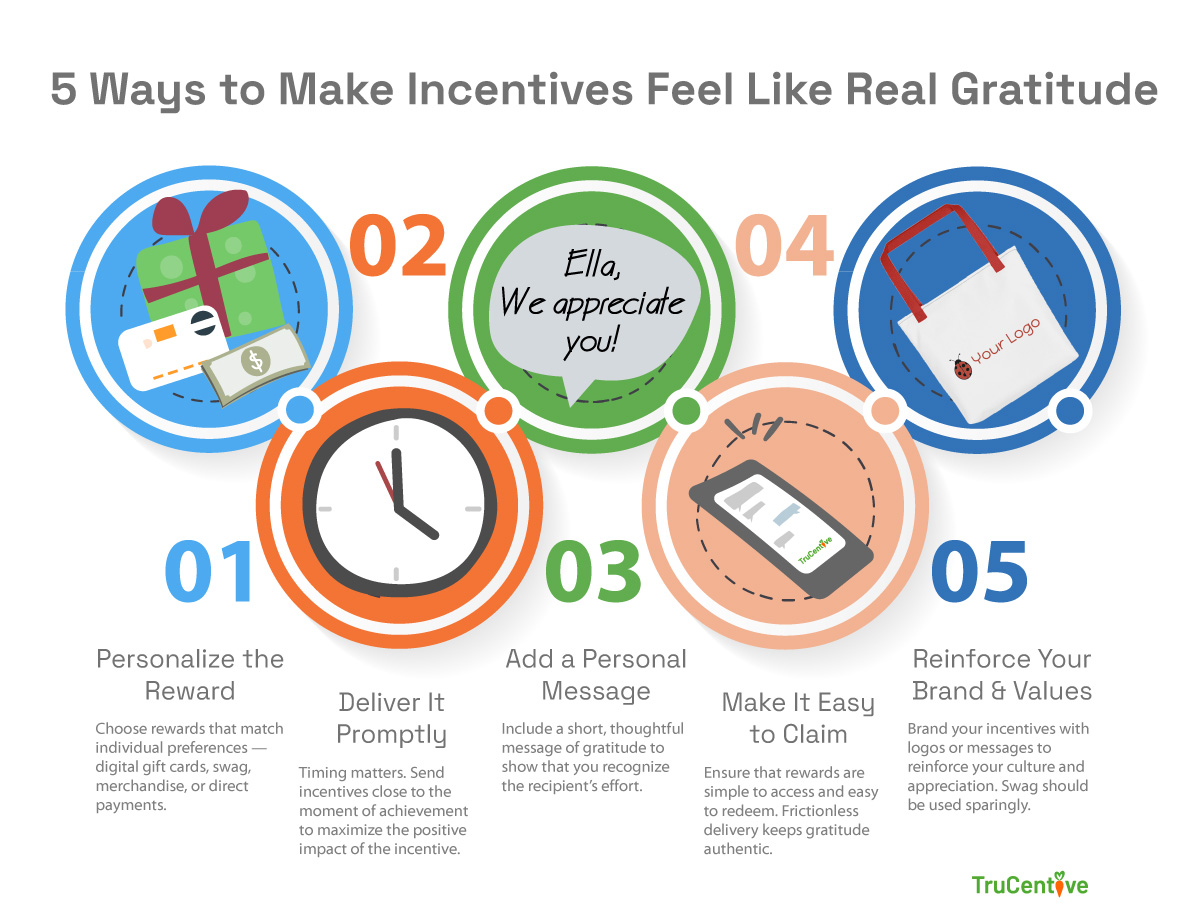
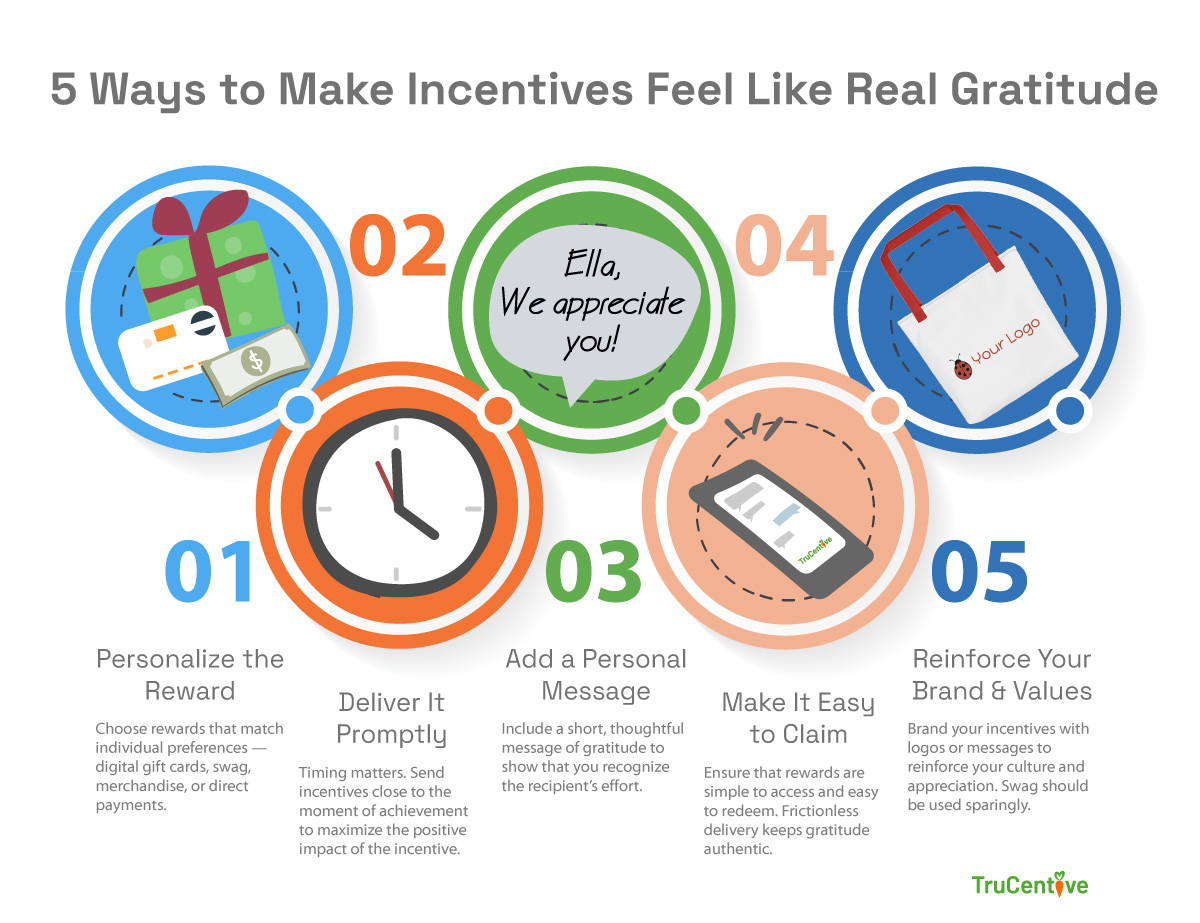
View the full-resolution “5 Ways Incentives Feel Like Real Gratitude” chart.
Related source: Taking Care of the People Who Matter Most: A Guide to Employee-Customer Care, Sybil F. Stershic.
Employees differ in whether, how, and when they want recognition. Collect preference input without requiring disclosure of religion, culture, disability, health, family status, or other sensitive information. Do not infer preferences from demographic or location data.
Employee recognition, customer or partner gifts, and research-participant payments require different rules. Participant reimbursement or compensation should follow the approved study protocol, consent materials, payment schedule, and oversight requirements; it should not be characterized as gratitude or depend on favorable responses. Customer and partner gifts may be limited by employer policy, procurement, anti-bribery, anti-kickback, healthcare, government, or industry requirements.
Recognition data alone does not demonstrate engagement, performance, retention, loyalty, advocacy, or ROI. Define the program objective, eligibility, approval, delivery, tax treatment, and evaluation method before launch. Use an appropriate baseline or comparison for outcome claims and avoid scoring an individual’s sincerity or gratitude.
An incentive can accompany a specific message of appreciation when the recipient is eligible and comfortable receiving it. Offer relevant choices, communicate the reason for recognition, and use a documented delivery schedule.
Automation may support workflows, reminders, and records for individual or larger programs, but scale and branding do not guarantee a personal or sincere experience. Review reward availability, fees, delivery timing, accessibility, recipient consent, data use, tax treatment, and gifting restrictions.
Offer eligible recipients a practical selection such as an available gift card, merchandise, charitable choice, private acknowledgment, or no-gift option. Keep values consistent for comparable criteria and provide accessible alternatives.
Tell recipients when recognition will be delivered and what to do if it is missing. Timing should follow approvals, payroll, program terms, and operational realities; an “instant” reward is not inherently more sincere or effective.
A specific message can explain the contribution being recognized. Use approved information and recipient preferences; do not infer sensitive traits or require public acknowledgment. Branding can identify the sender but does not prove relationship quality.
Unclear eligibility, timing, delivery, or support can create confusion about whether recognition was approved or sent. Publish the criteria and process, communicate delays, and provide an accessible way to correct errors or appeal a decision.
Recognition programs can create avoidable friction when choices, timing, access, communication, or distribution are poorly designed. The five risks below do not prove that a program will affect engagement, performance, morale, loyalty, or retention; they are process areas to review.
A standard reward may support equal treatment, but it may not fit every recipient’s needs. When practical, offer choices of equivalent value, accessible redemption, private recognition, and a no-gift or charitable alternative.
A delay can disconnect recognition from the contribution or violate a stated schedule. Distinguish discretionary recognition from promised wages, bonuses, reimbursements, or study payments, and follow applicable payment obligations.
Multiple logins, inaccessible pages, unclear instructions, device limitations, language barriers, or unavailable merchants can prevent use. Test the recipient journey and provide accessible support and alternatives.
Explain why the recipient is being recognized, the eligibility and terms, the sender, delivery timing, expiration, fees, tax treatment, privacy practices, and support route. A payout or gift without context should not be assumed to communicate gratitude.
Use documented, observable, role-appropriate criteria and comparable values. Train approvers, review distribution patterns across roles and demographic groups where lawful, provide an appeal or correction route, and do not rely solely on manager visibility or subjective “culture fit.”
Consider an illustrative scenario in which management promises recognition after an unusually busy audit period but delivery is delayed for months. The organization should communicate status, correct errors, and determine whether the promise was discretionary recognition or compensation subject to payroll, contract, wage-and-hour, or other legal requirements.
Employees should not be expected to work unpaid or unsafe hours to qualify for gratitude. Recognition does not resolve chronic overwork, staffing, pay, leave, or workload problems.
A peer-recognition points program may offer small merchandise choices. Low monetary value does not automatically make recognition meaningless, and high value does not guarantee sincerity. Review participation, manager involvement, accessibility, choice, communication, and whether points are distributed consistently rather than judging the program from anecdotes alone.
Consider a workplace using upbeat posters, emails, or mandatory wellness activities while employees report chronic overtime, weekend work, or unresolved safety issues. Recognition and wellness messaging do not substitute for investigating hazards, workload, staffing, compensation, leave, or employee concerns.
Mandatory meditation or public positivity activities may raise disability, religious, privacy, labor, and paid-time considerations. Separately, a digital gift should not require employees to praise company culture, waive rights, or conceal concerns.
The catch? Employees had to post a thank-you message about company culture on the internal social platform to claim it.
Start with documented, observable, role-appropriate criteria and comparable opportunities across roles, shifts, locations, and work arrangements. Invite preference input and offer choices of equivalent value without requesting sensitive personal information.
For employees, gift cards, cash equivalents, merchandise, and payments may be taxable compensation and may require payroll withholding or reporting. For customers and partners, review recipient-employer gift limits, anti-bribery, procurement, government, healthcare, and industry rules. For research participants, follow approved compensation and reimbursement terms rather than treating payment as a recognition gift.
Public recognition should require consent. Private acknowledgment, an accessible alternative, charitable choice, or no-gift option may be more appropriate for some recipients.
Define the approval and delivery schedule, communicate it, and provide a support path for missing or incorrect rewards. Same-day delivery is not required for meaningful recognition, and automation cannot eliminate payroll, compliance, funding, supplier, or review timelines.
Keep the claim process understandable and accessible. Confirm reward availability, fees, expiration, delivery channel, device and language support, replacements, and recipient location before launch.
Use clear instructions, accessible pages, supported devices, language options, and an alternative support route. Direct links and reminders may help some recipients, but do not guarantee delivery, redemption, or appreciation.
Use approved branding and a specific message to identify the sender and contribution. Do not require recipients to perform gratitude, endorse the organization, or share recognition publicly.
Systems may record eligibility, approvals, delivery status, redemption, support requests, and optional feedback. These measures can identify process issues, but they do not show whether a recipient felt grateful or prove engagement, performance, retention, loyalty, or ROI.
Minimize data collection, define access and retention, use aggregate reporting where practical, and avoid using redemption or feedback as an employment-performance score. Low redemption can reflect preference, availability, access, timing, fees, expiration, or communication—not a lack of appreciation.
Review recognition programs as roles, preferences, accessibility needs, catalog availability, and organizational policies change. Document revisions, test them with representative users, and monitor eligibility and distribution patterns for inconsistent access.
Technology may support eligibility workflows, messages, delivery, reminders, recipient choices, and reporting. It cannot determine sincerity or replace a manager’s specific acknowledgment, fair employment practices, or human support.
Available reward types, branding, delivery channels, security controls, funds handling, reporting, fees, refunds, expiration, and unclaimed-value treatment depend on the selected product, supplier, contract, and recipient location. Verify current documentation rather than relying on general compliance labels.
Build a project in the campaign builder with approved branding, recipient details, eligibility rules, and incentive selections. Reward availability, fees, delivery timing, expiration, cancellations, refunds, unclaimed-value treatment, and tax obligations depend on program terms, reward type, supplier, and recipient location. Related reading: employee gratitude and employee gratitude and appreciation.
Project scope, billing, recipient eligibility, and delivery requirements vary.
Confirm current security, privacy, payment, accessibility, tax, payroll, employment, anti-bribery, procurement, research, and other gifting-policy requirements.
A “thank you for your hard work” campaign rolls out across the company. Leadership sends a mass appreciation email, hands out branded coffee mugs, and decorates the halls with posters about teamwork.
Instead of feeling recognized, employees say “meh,” and respond with indifference. The gesture feels routine, more like a compliance exercise than a genuine expression of appreciation. The intention is good, but the connection is missing.
Gratitude is not just a courtesy. It is a core driver of engagement, trust, and performance. When employees feel seen and valued, they give more of their creativity, focus, and loyalty. When recognition feels generic or off-target, it can erode morale instead of building it.
Incentives, when designed thoughtfully, are the language of gratitude. They translate appreciation into something tangible and memorable. Yet many organizations still get it wrong.
The way to fix it isn’t necessarily just about spending more. The answer is to listen better, understand what employees value, and make gratitude personal, timely, and real.
The workplace faces a “gratitude gap.” Employees expect more recognition than they receive, and customers increasingly want to feel like partners, not transactions. In research and healthcare studies, participants expect their contributions to be acknowledged in a meaningful, timely way—not as an afterthought.
Studies consistently show that appreciation drives performance. Gallup’s research links recognition-rich cultures to 31% lower turnover and higher engagement. Deloitte found that organizations with strong recognition programs are 12 times more likely to generate positive business outcomes.
Gratitude has tangible returns. It fuels motivation, loyalty, and trust. For brands, it creates a ripple effect that turns appreciation into advocacy and routine participation into lasting relationships.
Incentives make gratitude visible and measurable. When they’re designed as genuine expressions of thanks, and are sincere, they can be powerful.
Gratitude speaks through action. In organizations, incentives are how gratitude gets translated. Incentives are tangible symbols that say, “We see you, we value what you’ve done, and it matters.”
The best incentives do three things well:
Choice makes gratitude genuine
Everyone values something different. A digital gift card, branded merchandise, or charitable donation—choice ensures the “thank you” feels like it was meant for me.
Speed makes gratitude timely
An instant reward creates emotional resonance. A delayed thank-you delivered weeks or months later can lose its impact.
Personalization makes gratitude memorable
A short, thoughtful message or branded delivery experience reinforces the relationship and who the gratitude is coming from.
With today’s incentive automation, organizations no longer have to choose between the ability to scale and personalization. Automated systems can deliver personal, branded, expressions of thanks to individuals or to hundreds of employees without losing the human touch.
If gratitude and incentives are such such powerful gestures, why do so many “thank-you” efforts fall flat?
Research shows that recognition and gratitude have measurable effects on engagement, performance, and loyalty. When employees feel genuinely seen and valued, their motivation, productivity, and commitment increase.
Most organizations fail not because they lack appreciation, but because they poorly translate it.
Here’s where a few things may go wrong:
Generic incentives
When everyone receives the same gift card or token, without any personal choice, it sends the opposite of a personal message. Uniformity may be efficient, but it’s rarely meaningful.
Delayed delivery
A thank-you delivered months after the contribution misses the emotional moment. Gratitude, like humor, has timing, and it works best when it’s fresh.
Complex redemption processes
When recipients struggle to access or use their reward, frustration replaces appreciation. A “reward” that requires multiple logins or steps often feels like work.
Poor communication
Presentation matters. Sending a gift card without context, without a message, or without explanation doesn’t drive home the sense of gratitude Gratitude without telling the recipient thanks is just a payout.
Inconsistent or unfair
When incentives are unevenly distributed or based on favoritism, they erode trust instead of building it.
When people aren’t sure if they’ve been recognized or when they’ll receive something, they start to wonder, Did you forget me?
Many well-intentioned efforts fall flat because they rely on generic, delayed, or overly complicated gestures, tactics that can leave employees feeling overlooked rather than appreciated,
Rewards were promised by management as an incentive and thank you for folks asked to work through an unusually busy audit season. Delays pushed the awards back months.
The awards lost the connection between the effort and the recognition. Failing to fulfill the promise in a timely manner became a source of frustration and complaint.
A peer recognition program meant that employees could send each other points to redeem for small gift items and prizes, in an effort to bring appreciation to every level.
The award offers included just small, branded items and little of real value. Managers rarely took part. Employees stopped using it within months and it became a punchline (I’ll give you 20 points for attending my meeting.:)
A mid-sized manufacturing company launched a “Smile Fridays” campaign during a period when employees were facing chronic overtime, mandatory weekend shifts, and a backlog of unresolved safety complaints.
The initiative included upbeat posters in the breakroom, a weekly “fun fact” email from HR, and a mandatory 5-minute virtual meditation session for all staff.
An administrative services company sent every employee a $25 digital gift card “to show our appreciation for your commitment.” $25 is always good? Right?
The catch? Employees had to post a thank-you message about company culture on the internal social platform to claim it.
Turning incentives into real expressions of gratitude isn’t about bigger budgets—it’s about better design. The most effective organizations follow five simple principles:
Gratitude lands best when it feels specific. Tailor incentives to the recipient’s context or preferences.
For employees, that could mean digital gift cards, merchandise, or direct payments. For research participants, flexible and immediate reimbursement options show respect for their time. Personalization transforms a generic gesture into an authentic one.
Appreciation should be delivered close to the moment of action. A same-day thank-you note or instant payout carries emotional weight that a quarterly recognition event can’t match.
Automation now makes this achievable at any scale. Gratitude doesn’t have to wait for accounting cycles.
If the recipient has to work to receive or redeem their thank-you, the message is lost.
Frictionless delivery with direct links, mobile accessibility, and automated reminders ensures that gratitude is not only given but actually felt.
An administrative services company sent every employee a $25 digital gift card “to show our appreciation for your commitment.” $25 is always good? Right?
The catch? Employees had to post a thank-you message about company culture on the internal social platform to claim it.
Modern incentive systems can track engagement, redemption, and feedback. These insights reveal what types of appreciation resonate most, helping refine strategies over time.
Gratitude isn’t static. Gratitude should evolve as people and expectations change.
The irony of modern gratitude is that technology, often seen as impersonal, can actually make appreciation more human.
Platforms like TruCentive allow organizations to scale gratitude without sacrificing sincerity. Automated workflows ensure that “thank you” messages arrive instantly and consistently. Flexible delivery options—digital gift cards, merchandise, branded swag, or payments—let recipients choose what feels meaningful.
Brand control and compliance features keep messaging consistent, funds secure, and reporting transparent. Refund management ensures budgets stay efficient, while the end-user experience stays effortless.
When technology takes care of logistics, people can focus on connection. The result: gratitude that feels both authentic and automatic.
You may get started today to see how it works. Send sample expressions of gratitude and incentives to yourself or colleagues in just a few minutes. You don’t need to enter a credit card to try out designing and sending a splendid sample to see how straightforward using incentive automation can be.